Åse Maria Kleveland (born 18 March 1949 in
Stockholm) is a
Swedish-
Norwegian singer and
politician.
A well-known folk singer and traditional guitarist in Norway, she was appointed
Minister of Culture in Norway from 1990 to 1996, representing the Labour Party under the
Gro Harlem Brundtland administration. She was also president of the
Swedish Film Institute from 1999
[1] to 2006.
In June 2007 she became
Chairman of the Board of
Human-Etisk Forbund, the Norwegian
humanist organization.
Kleveland was born in Sweden to Olaf Kleveland, a civil engineer from Norway, and Eva Hansson, a bookkeeper from Sweden. Her father had fled from Norway to Sweden in 1943 due to the
Nazi occupation; he had family members in Sweden with whom he could live. She and her family moved to
Romerike, northeast of
Oslo, in 1957,
[1] where her father got a job working at the Institute for Atomic Energy.
[2]
In a 1977 interview she describes how her parents shared equally in the household chores, and that she and her then-husband Svenolov Ehrén, a Swedish artist, did the same.
[3] She is currently married to film director and cinematographer Oddvar Bull Tuhus.
Kleveland is fluent in Norwegian, Swedish, English, French and Japanese. She studied
Law at the
University of Oslo.
As a singer, she is famous for her very dark, soulful voice. Besides singing, she also plays the
guitar and has composed songs in the
singer-songwriter tradition. In addition to her solo career, she was also part of the
vispop group
Ballade!.
She began playing
classical guitar at eight and two years later she debuted in a radio show.
[1] Her first bout as a singer of
vispop was on an
Erik Bye show when she was 13; Her first album was released in 1965.
[1] With her second album in 1966
[1] she was one of the pioneers ushering in the new
vispop genre, a blend of traditional
folk song and
pop. This led to a series of engagements in
Paris--and a period of commuting between these Paris performances and her secondary school in
Lillestrøm, north of Oslo. At 17 she conducted a major tour of
Japan which included several TV shows and the release of four
singles in
Japanese.
[1][3] She released her final solo album in 1973
[1] and has released thirteen singles for the Scandinavian and German markets.
[1]
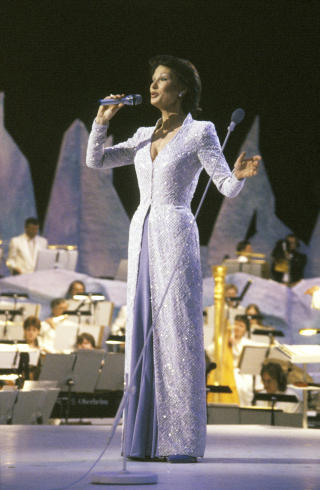
In 1966, she represented Norway in the
Eurovision Song Contest with the entry "
Intet er nytt under solen" (
There's Nothing New Under The Sun), finishing in third place. She broke a tradition expected of female performers at the time in that she was the first woman to not to wear a dress, instead going for a pantsuit.
[5]
She had a long association with the Norwegian Association of Musicians, first holding the office of secretary from 1979 to 1983,
[1] then as their leader from 1983 to 1987.
[1] She was also the President of the Musicians' Union from 1983 to 1986 and their Vice-President from 1986 to 1987.
[1]
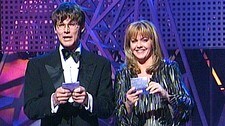
In 1986 she hosted the first
Eurovision Song Contest to be held in Norway in
Bergen following
Bobbysocks' victory in 1985, having previously introduced the Norwegian entry on camera at the
Eurovision Song Contest 1980.
From:
http://en.wikipedia.org/wiki/%C3%85se_Kleveland
 |
| During her performance in the 1966 contest. |
 |
| As the host in 1986. |